
Yes — you can sell your house as-is without making any repairs. You are not legally or practically required to fix anything before selling. The real question isn’t whether you can sell as-is. It’s whether you should — and that depends entirely on your situation, your timeline, and what you’re trying to accomplish.
This guide is written by Zach Shepard, founder of Braddock Investment Group, a Chicago-based cash home buying company with over 17 years of experience purchasing distressed properties throughout Chicago and the Chicagoland suburbs. We’ve bought hoarder houses, fire-damaged properties, mold-filled condos, and everything in between. Here’s what sellers actually need to know.
What “Selling As-Is” Actually Means
Selling as-is means you’re putting the property on the market in its current condition — no repairs, no cosmetic updates, no cleaning required. You disclose what you know about the property’s condition, and the buyer accepts it as they find it.
This is different from a traditional home sale, where buyers often request repairs after an inspection, and sellers either fix items or negotiate a price reduction. In an as-is sale, that back-and-forth is largely eliminated.
Who Is Selling As-Is Right For?
Every week, sellers call us and open with some version of: “I just want to sell the house the way it is.” When we dig deeper, we find the same underlying fear almost every time — they’re worried they’ll get a lowball offer, or that the price will quietly drop after a series of repair requests or inspection findings.
Beneath that, there’s usually a life situation driving the urgency. Selling as-is makes the most sense when:
- You don’t have the money to fund the repairs upfront
- You can’t find or manage a contractor reliably — or you’ve been burned before
- You don’t have the time to oversee a renovation project
- You need a fast, certain outcome — not a maybe that depends on inspection results
- The emotional weight of the property is already too much to carry through a months-long process
If you can fund the repairs, manage the contractors, absorb cost overruns, and wait for the right retail buyer — you’ll likely net more money fixing it up first. We’ll tell you that directly. But most sellers calling us aren’t in that position. And that’s exactly who as-is selling is designed to serve.
Should You Make Repairs Before Selling? The Honest Framework
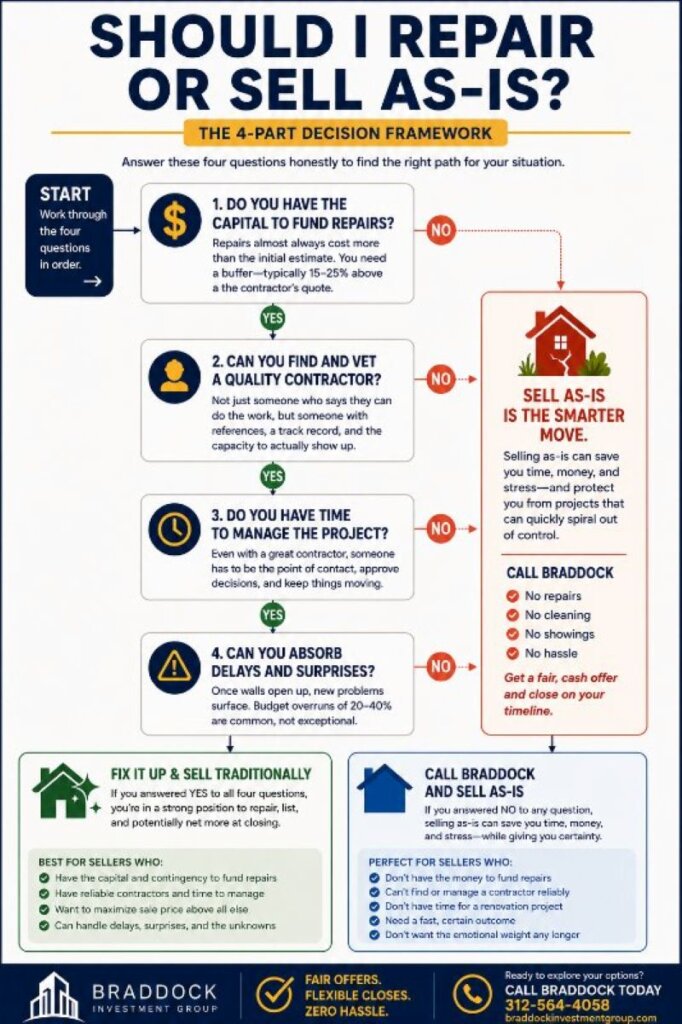
Here’s how we walk sellers through this decision. Before committing to repairs, ask yourself four questions:
- Do you have the capital to fund them? Repairs almost always cost more than the initial estimate. You need a buffer — typically 15–25% above whatever a contractor quotes you.
- Can you find and vet a quality contractor? Not just someone who says they can do the work, but someone with references, a track record, and the capacity to actually show up. This is harder than it sounds.
- Do you have time to manage the project? Even with a great contractor, someone has to be the point of contact, approve decisions, and keep things moving. That’s time and mental bandwidth.
- Can you absorb delays and surprises? Once walls open up, new problems surface. Budget overruns of 20–40% are common, not exceptional.
If you can answer yes to all four — and you want to maximize sale price above all else — making repairs first is probably the right call. If any of those four are a genuine “no,” selling as-is protects you from a project that can easily become more expensive and more stressful than the property is worth.
What Does the As-Is Sale Process Look Like?
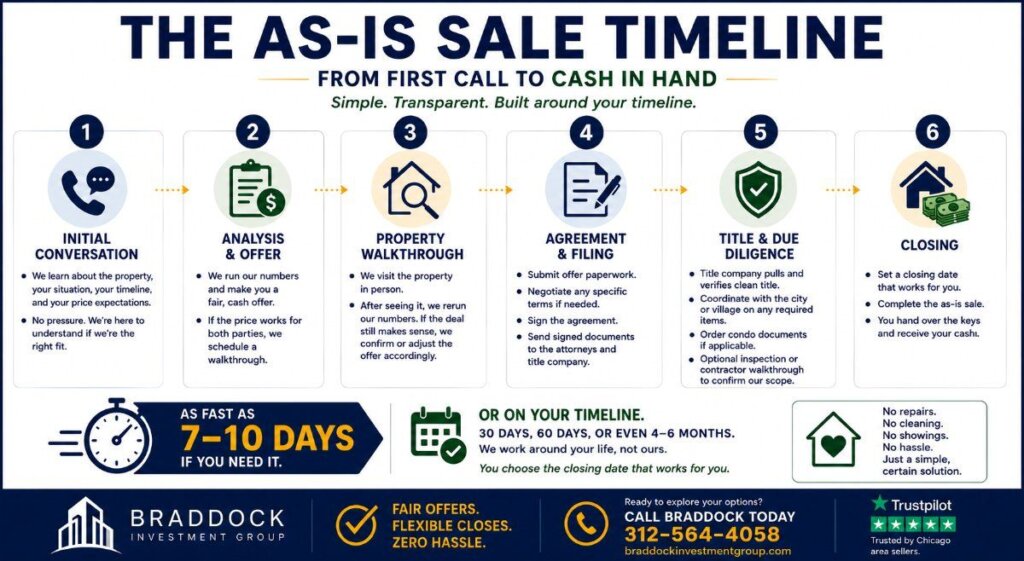
Here’s exactly what happens when you call Braddock Investment Group:
Step 1: Initial Conversation We ask about the property, your reason for selling, your timeline, and your price expectations. No pressure. We’re trying to understand if we’re the right fit.
Step 2: Analysis and Offer We run our numbers and make an offer. If the price works for both parties, we schedule a walkthrough.
Step 3: Property Walkthrough We visit the property in person. After seeing it, we rerun our numbers. If the deal still makes sense, we confirm or adjust the offer accordingly.
Step 4: Agreement and Filing
- Submit offer paperwork
- Negotiate any specific terms if needed
- Sign the agreement
- Send signed documents to the attorneys and title company
Step 5: Title and Due Diligence
- Title company pulls and verifies clean title
- Coordinate with the city or village on any required items
- Order condo documents if applicable
- Optional inspection or contractor walkthrough to confirm our scope
Step 6: Closing
- Set a closing date that works for you
- Complete the as-is sale
- You hand over the keys and receive your funds
How fast can this happen? As little as 7–10 days if you need it. Or 30 days, 60 days, even four to six months — we work around your life, not ours. If you need time to find a new place or relocate out of state, the timeline bends to fit. We work with sellers across Chicago and the suburbs on their timeline — whether you need to sell your Palatine home as-is for cash in two weeks or need four months to relocate.
The Biggest Misconception That Costs Sellers Months of Their Life
This is the one we see most often, and it’s painful to watch.
A seller gets our offer, decides it’s too low, and walks away thinking they can do better — either by fixing the house themselves or listing with an agent. Three to four months pass. The repairs stall. The contractor disappears with a deposit. The listing sits. And the seller ends up accepting an offer at or below what we originally presented.
Here’s what sellers don’t understand in that moment: our offers reflect the true market value of a property in that condition — what a reasonable buyer is actually willing to pay for a house that needs work. It’s not a lowball. It’s a market reality that takes most sellers a few months to independently verify.
And during those months, the seller has spent money they didn’t need to spend, time they didn’t need to lose, and in some cases, the condition of the property has actually gotten worse — which means the eventual sale price is lower, not higher.
We’re aware that we become the “bad guy” in that initial conversation. We’ve made peace with it. The sellers who come back six months later — sometimes after a contractor ran off with their money — tell us they wished they had taken the deal.
What Condition Is Actually “Too Far Gone”?
Not as far gone as you think.
We’ve purchased properties most buyers wouldn’t walk into. Here are real examples:
The hoarder house with frozen pipes and a sunken floor. A seller was living in squalor — no heat, frozen water lines, sleeping on a mat in the hallway. After we purchased and cleaned out the house, we discovered the water pipes had burst and had been running, destroying the floor joists beneath. The floor had sunk 3–5 inches along the center of the house. That was a $5,000–$6,000 change order we absorbed. We still made the deal work.
The inherited condo where the aunt passed. A seller inherited a property from a relative who had passed away inside the unit. It had been several days — possibly longer — before she was found. The smell had permeated everything. We gutted it entirely, walls included. We still closed.
The house where the owner never went upstairs. A seller with back problems couldn’t manage the second floor of her own home. Her animals had been using it as a bathroom for years. The house was deteriorating around her. She needed cash, and she needed out. We bought it.
When we walk a property, what we’re actually evaluating are the structural fundamentals:
- Foundation issues — sloped floors, crumbling columns, significant settlement
- Roof condition — age, active leaks, underlying deck damage
- Long-term water intrusion — damage to framing, structure, or systems over time
Mold is not a deal-killer. A damaged roof is not a deal-killer. These are scope items, not exit ramps. What we need to understand is the full extent of the damage — and we have 17 years of Chicago-specific experience to assess that accurately.
See more Chicago seller stories here.
Why Chicago Sellers Should Be Careful Choosing a Cash Buyer
The “we buy houses” industry has grown fast, and not all of it has grown well.
There are two kinds of buyers sellers should be cautious about:
Inexperienced local operators who understand deal structures from YouTube but have never actually managed a renovation. They’ll agree to a price, get into the project, and either back out after inspection or underestimate the work so badly they can’t close.
Out-of-market companies — particularly from the East and West Coasts — that are buying Chicago properties remotely without genuine knowledge of Chicago building types, Chicago building codes, or Chicago-specific repair costs. They’ll make an offer based on algorithm-driven comps, send an inspector who doesn’t know what they’re looking at, and pull out at the worst possible moment.
Braddock has been buying and rehabbing homes in Chicago and the Chicagoland suburbs since 2009. We’ve seen essentially every property type and condition this market produces. We’ve also seen every seller situation: inherited properties with multiple siblings who can’t agree, divorce situations, hoarder estates, vacant buildings sitting for years, landlords exhausted by problem tenants, and everything in between.
When we make an offer, we know what we’re looking at. We don’t back out because we missed something on the walkthrough.
The Question You Should Answer Before You Call Anyone
Before you call us — or any cash buyer — get clear on your end goal.
- Are you trying to move on to the next chapter of your life?
- Do you have family members depending on the funds from this house?
- How much time and energy are you actually willing to put into this property?
- Does it make more sense to invest months into fixing it up, or to take a fair offer now and redirect that time into what comes next?
Selling as-is isn’t giving up. For the right seller in the right situation, it’s the most rational decision available. It unlocks capital, eliminates uncertainty, and — maybe most importantly — it gives people permission to stop carrying a burden they’ve been carrying for a long time.
The sellers we’re most proud to have worked with are the ones who used the proceeds to take care of a parent, relocate to a better climate, walk away from a bad tenancy, or simply start fresh somewhere new. That’s not a consolation prize. That’s the point.
Frequently Asked Questions
Can I sell my house as-is if it has major foundation problems? It depends on the severity. Significant foundation issues — crumbling columns, severe settlement — affect our ability to make the numbers work. But many foundation concerns are repairable, and we assess them case by case. Call us and describe what you’re seeing; we’ll tell you honestly whether it’s workable.
Do I need to disclose problems if I sell as-is? Yes. Selling as-is does not exempt you from disclosure requirements. In Illinois, sellers are required to disclose known material defects. As-is simply means you’re not agreeing to fix them — not that you’re hiding them.
Will I get a fair price selling as-is? A fair price for an as-is property reflects its current condition — not its potential after repairs. Our offers account for the cost of bringing the property up to standard, plus our holding costs and margin. What we can tell you is that sellers who decline our offer and attempt repairs themselves frequently end up at or below our original offer price several months later.
How is selling to a cash buyer different from listing as-is with a Realtor? Listing as-is with an agent still puts you on the open market, which means showings, longer timelines, buyer financing contingencies, and inspection requests — even if you’ve stated you won’t make repairs. Selling to a cash buyer like Braddock eliminates most of that. No showings, no financing contingencies, flexible closing date, and certainty.
What if I inherited a property and don’t know its condition? This is one of the most common situations we handle. We’ll walk the property with you, give you an honest assessment, and make an offer based on what we see — not what you think it might be worth. You don’t need to know anything about the property’s condition to start the conversation.
Ready to Talk?
If you have a Chicago or Chicagoland property you’re thinking about selling as-is, we’d like to hear about it.
Braddock Investment Group has been buying houses in this market since 2009. We close on your timeline. We don’t back out after inspections. And we’ll give you a straight answer on what your property is worth to us — no pressure, no games.
[Call us or fill out our form to get a no-obligation cash offer →]